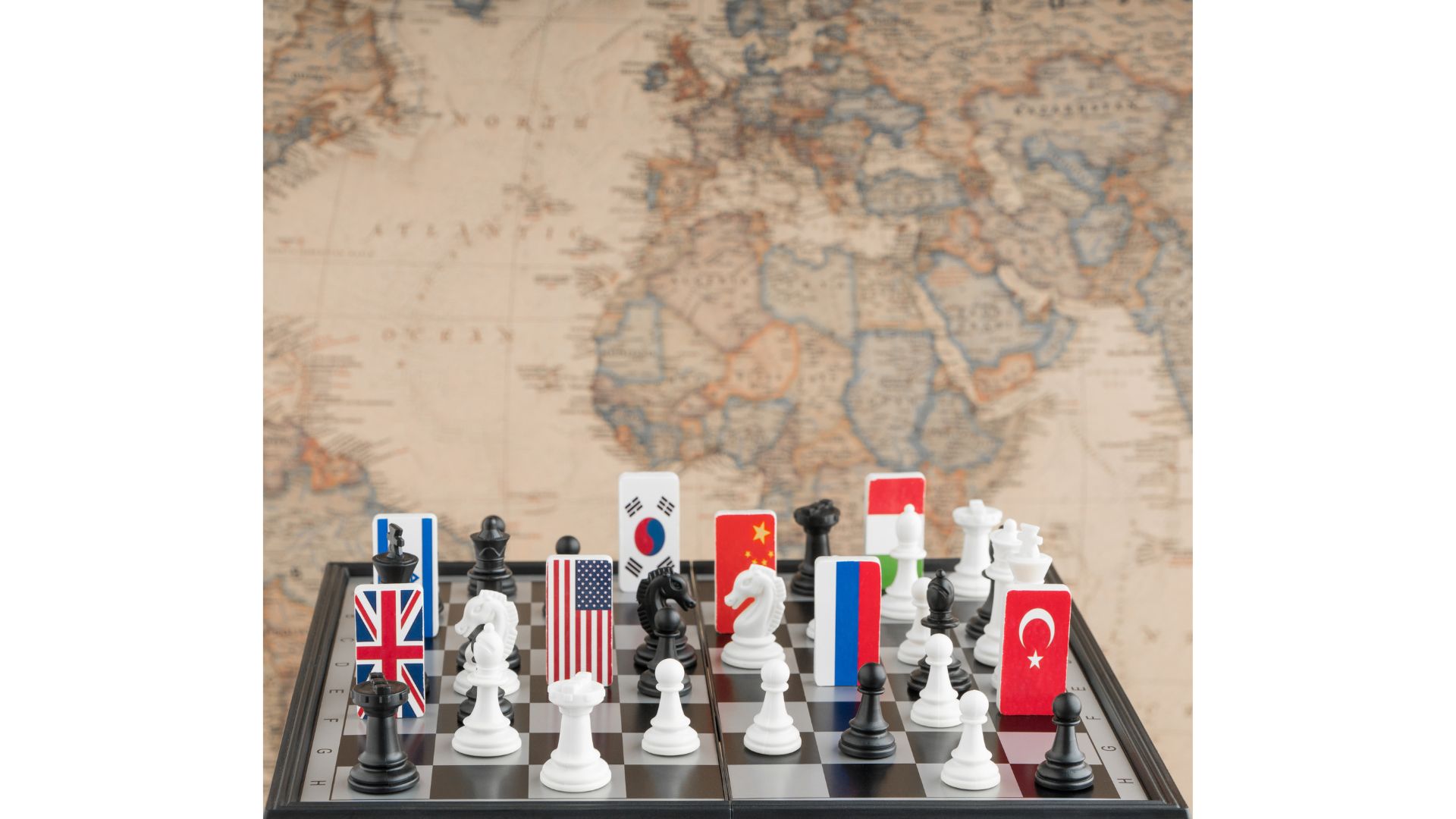
When Donald Trump returned to the White House, the central axis of his foreign policy was clear: containing China. Yet by spring 2026, the situation has become paradoxical. The war in Iran, intended as part of a broader strategy to limit Beijing’s influence, is instead creating conditions from which China may benefit.
Originally published in Postimees (Estonian): Trumpi ristiretk algas siit. Nüüd peab Hiina plaani
This does not mean that Beijing has “won” the conflict. Rather, an asymmetrical balance has emerged: one major power expends resources and takes risks, while the other patiently extracts advantage from the same crisis – learning, adapting, and allowing its rival to exhaust itself.
War as a tool – and its unintended consequences
At first glance, the logic of the Trump administration was understandable. Strikes in Iran and earlier in Venezuela were not merely regional operations, but part of a broader effort to weaken China’s position. Both countries were important to Beijing as political partners and sources of energy.
Up to 15% of China’s oil imports came from Iran and Venezuela, often at discounted prices and despite sanctions. Washington’s calculation was simple: weaken these regimes, disrupt China’s access to cheap energy, and increase pressure on Beijing. But geopolitics rarely follows a linear logic.
China is indeed highly dependent on Middle Eastern energy – up to 45% of its oil imports pass through the Strait of Hormuz. Yet it is Beijing that appears to be benefiting from the crisis. Why?
The United States is spending. Modern warfare involves not only political risk but also a massive material burden – from missile defense systems to logistics. Resources and attention are shifting away from the Indo-Pacific toward the Middle East.
China, meanwhile, observes. Its military and analysts study the conflict in detail: which systems work, where vulnerabilities appear, how logistics function. This is, in effect, a practical exercise – and one that comes at no cost to Beijing.
China is learning not only from the war in Iran, but also from Ukraine, including in areas such as drone warfare. It also becomes clear that the resilience and readiness of adversaries are often underestimated. Douglas MacArthur made a similar miscalculation at the start of the Korean War in 1950, assuming China would not intervene seriously or was incapable of doing so. When UN forces reached the Yalu River, a sudden and forceful Chinese counterattack changed the course of the war. China was not perfectly prepared – but it was sufficiently prepared. The same logic applies today: the assumption that China’s armed forces are not ready for conflict may be dangerously simplistic.
The most important shift, however, is not on the battlefield, but in perception.
Perception as a source of power
After the Cold War, the international order largely rested on the perception of the United States as a stabilizing force. When that perception begins to erode, it does not collapse overnight, but gradually – as described by Edward Gibbon in his account of imperial decline.
The war in Iran accelerates this process. The more unpredictable and forceful Trump appears, the easier it becomes for Xi Jinping to present himself as a more measured and cautious leader. This does not mean China has become more moderate, but the contrast works in its favor.
At the same time, this should not be interpreted as Chinese dominance. It is rather an example of adaptation in a situation that Beijing does not control. China is not setting the pace of the game, but seeking to maximize advantage from a crisis driven by Washington.
China’s priorities: less rhetoric, more direction
It is useful to look at the priorities outlined during China’s National People’s Congress in early March. Interestingly, the United States was largely in the background, with little direct criticism – even in light of events in Iran. This restraint was not accidental.
China is focusing on what matters in the long term: technological self-sufficiency, particularly in semiconductors and artificial intelligence; adapting its economy to slower growth (with a 2026 target of 4.5–5%); maintaining strong export performance, which grew by over 20% at the start of the year; continued increases in defense spending, reaching $278 billion; and addressing internal challenges, particularly in the property sector and domestic consumption.
The cautious tone toward the United States likely reflects the planned summit, but more broadly the need to maintain stable relations at a time of ongoing economic and domestic pressures.
A postponed visit – more than a diplomatic detail
Trump’s planned visit to Beijing at the end of March was meant to be a major geopolitical event, but has now been postponed by several weeks. This is not merely a logistical issue.
On the one hand, it suggests that the Iran operation has not unfolded as quickly or as controllably as expected. On the other, it highlights the difficulty of combining military escalation with high-level diplomacy.
Yet neither side can simply cancel the meeting. Trump needs it to demonstrate that his pressure strategy is working and to maintain control over relations with China. Xi needs it just as much, for economic reasons and to preserve China’s international image.
This creates a paradox: both sides need dialogue, yet neither can afford to appear weak.
What has changed?
Before the escalation of the Iran conflict, US–China competition focused primarily on trade, technology, global supply chains, and Taiwan. Now, the Middle East has become an additional dimension.
Trump’s expectation was that weakening Iran would allow the United States to refocus on Asia. In reality, the opposite has occurred: attention and resources have become more dispersed.
China, meanwhile, has not altered its core direction. It continues to invest in technology, expand military capabilities, and maintain economic stability, even as growth slows.
A gradual shift in the global order
The war in Iran fits into a broader transformation, in which the international balance is gradually shifting toward a more multipolar system.
Efforts by BRICS countries to reduce dependence on the dollar, the desire of Gulf states to diversify risk, and China’s role as a diplomatic mediator – for example in the Saudi–Iran rapprochement of 2023 – all point in the same direction.
If US actions are increasingly perceived as destabilizing, this process will accelerate. Not abruptly, but gradually – as American influence diminishes and alternatives become more attractive. China is positioning itself as such an alternative.
Does Trump’s strategy work?
It would be too simplistic to say that Trump’s strategy has failed. Weakening Iran may indeed limit China’s access to cheap energy. It also demonstrates that the United States is willing to use force, which may reinforce deterrence.
However, the question is not only what Washington gains, but also what it must expend to achieve it.
If the United States becomes more deeply engaged in the Middle East, its flexibility elsewhere – particularly in the Indo-Pacific – is reduced. As resources become stretched, it becomes harder to maintain focus on China, which was the original objective.
China’s greatest strength in this situation is not necessarily its economy or military, but time. Beijing does not need to rush. It does not need to respond to every move. It can afford to wait and adapt – something often underestimated in Western systems shaped by electoral cycles.
This does not mean China controls the situation. It means it can maintain direction in an uncertain environment and avoid overreaction.
Who really benefits?
The war in Iran is not yet over, and its final outcome remains uncertain. However, it has already altered the balance between the United States and China.
Trump’s objective was to pressure China by weakening its partners and energy channels. Instead, a different situation has emerged: the United States bears the direct costs and risks; China gains experience and seeks to extract advantage from the same crisis; and the international perception gradually shifts in Beijing’s favor.
This is neither a clear victory nor a clear defeat. It is a war of attrition, in which one side takes the initiative and pays the price, while the other accumulates advantage over time without taking equivalent risks.
And in this dynamic, at least for now, Beijing appears more patient, though not necessarily in full control of the game.
For more analysis on Europe’s economic and geopolitical transformation, see:
What comes after capitalism? Europe and the future economic system