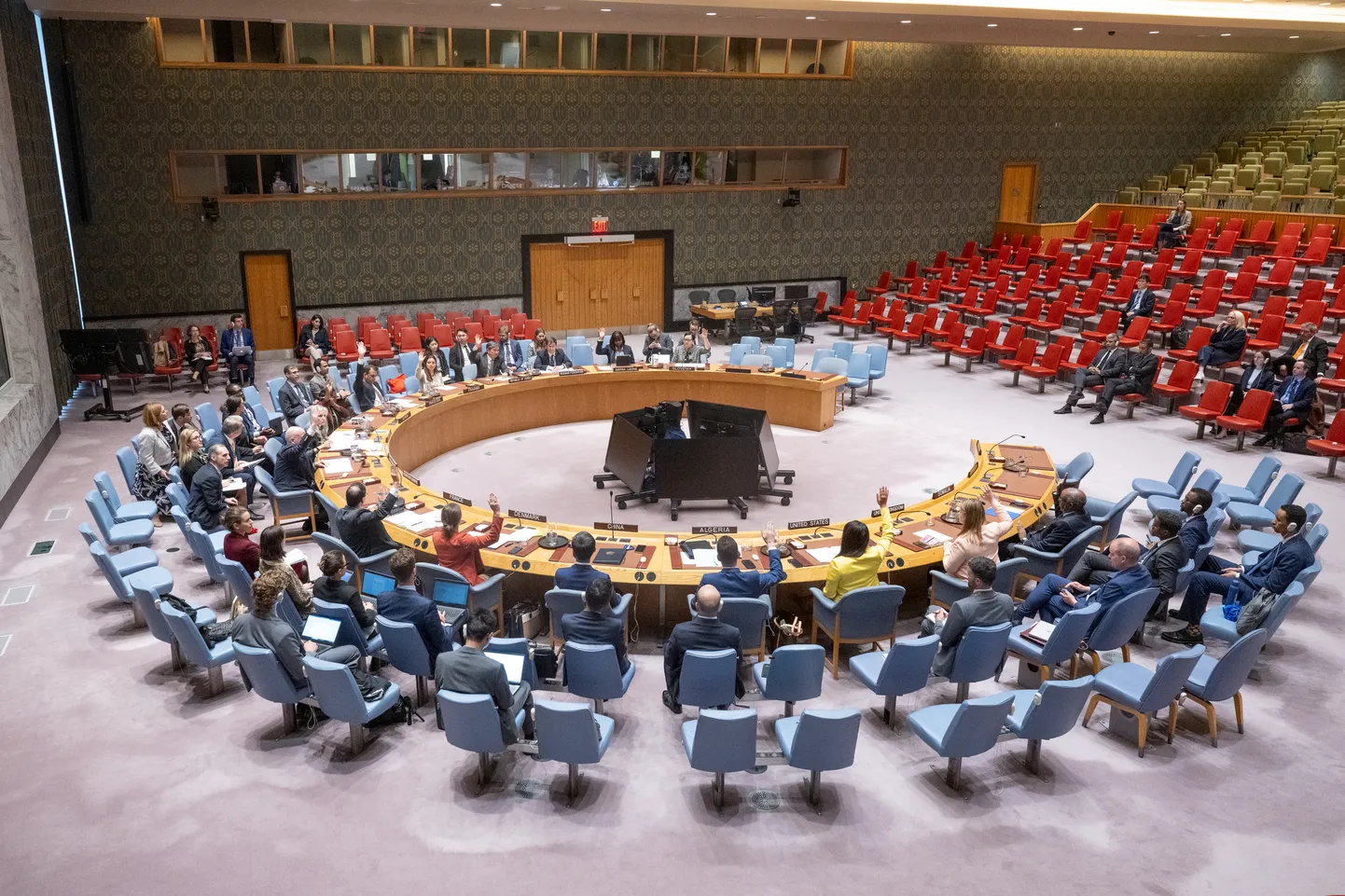
Originally published in Postimees on 26 September 2025. Clyde Kull analyses the future of the United Nations in the context of Donald Trump’s foreign policy.
- It is not difficult to think back ten years and imagine a different course of history.
- As tempting as it may be, blaming Trump alone would be too simplistic.
- Western power and influence have not disappeared, but their structure has weakened and become less predictable.
If the Western era is over, what will happen next? There is no single answer, but one thing is certain: the world is becoming more multilateral.
Somewhere in a parallel universe, the 80th anniversary of the United Nations is a modest but joyful event: glasses are raised to toast achievements and take stock of the long journey that still lies ahead.
A time to celebrate milestones and learn from missed opportunities. Above all, a time to renew our shared commitment to overcoming global challenges.
Instead, in September 2025, the mood on Earth is uniformly gloomy. If the UN is not in “free fall,” it is suffering from a “crisis of relevance.” Perhaps it is no longer fit for purpose. Tom Fletcher, the organization’s senior humanitarian official, summed it up best: The UN-led international system faces a “perfect storm: underfunded, overstretched, and under attack.”
Was it meant to be this way?
It is not difficult to think back ten years and imagine a different course of history. In 2015, UN member states adopted the Sustainable Development Goals (SDGs) – an ambitious 17-point action plan aimed at eradicating poverty and hunger, halting climate change, and ensuring peace and prosperity for humanity by 2030.
Then-US President Barack Obama did not portray this initiative as idealistic, but as an enlightened exercise in self-interest. “Supporting development is not charity, but one of the smartest investments we can make in our future,” he said in a speech to the UN General Assembly in 2015. “Ultimately, it is the lack of development—when people have no education, no jobs, no hope, and feel that their basic human dignity is being violated—that creates tension, conflict, and instability in our world.”
“The United States will remain your partner in this work,” Obama added. “In times of disaster and crisis, the world can count on the friendship and generosity of the American people.”
Ten years later, the world is facing a situation where it can no longer rely on the United States. Not only has President Donald Trump liquidated the United States Agency for International Development and ended funding for the United Nations , his administration has condemned the SDGs as a “globalist enterprise” influenced by “gender equality and climate ideology” and “contrary to the sovereignty of the United States.” Indeed, the current concern about the situation at the UN is whether the organization will even survive Trump’s second term.
As tempting as it may be, blaming Trump alone would be too simplistic. The 2030 Agenda already contained some seeds of failure—assumptions that relied on the continued leadership of Western countries, global partnerships, and financing, even though these were not guaranteed. Looking at the world as a whole, it is clear that development does not automatically function as a mechanism for creating peace and stability. Even the best intentions can fall prey to geopolitical disruptions and regional conflicts under the Western-led order.
For example, Rwanda and Ethiopia, both success stories in terms of development, have in recent years pursued policies that fuel conflict and destabilize regions. Such examples illustrate how development gives countries real power: the ability, for better or worse, to project force, shape narratives, and pursue national projects. The results of development are not neutral—they alter the balance of power and the geopolitical landscape.
This perspective also shows why the optimistic logic of Western countries may not always work. The link between poverty reduction and increased peace, emphasized in Obama’s 2015 speech, is more complex when development capacity is unevenly distributed and geopolitical influence becomes more diverse. The foundation of the Western-led global order began to crack even before Trump, although his administration accelerated its fragmentation.
This does not mean that the SDG vision was flawed. On the contrary, it represented an extraordinary and comprehensive effort to make the world a better place. However, this vision was based on a world without conflict, where Western countries would maintain their advantage and be able to control global development in a way that did not threaten the existing order and balance of power. If these assumptions do not hold true, the foundations for implementing the SDGs will crumble, and with them the broader international order that extends beyond Trump, even if he turned out to be the wrecking ball that brought down the entire existing order.
Indeed, there is currently a bipartisan consensus in the US that the liberal international order is dead, that the United States’ post-Cold War grand strategy of “hegemony” based on enlightened self-interest within a rules-based order is no longer viable.
Both US and European leaders feel weary and are less willing to act collectively based solely on shared values. Western power and influence have not disappeared, but their structure has weakened and become less predictable.
If the Western era is over, what comes next? There is no single answer, but one thing is certain: the world is becoming more multilateral. Medium-sized countries are beginning to play a greater role in setting rules and shaping their environment. As Canadian Prime Minister Mark Carney recently emphasized, it is important to recognize our strengths and leverage them. In fact, this is not a transition, but a turning point: the world does not expect Washington to return to its former position.
The main burden in this future order will likely fall on Asia, the world’s economic engine, which accounted for more than half of global GDP growth between 2015 and 2021. Asian and Pacific countries have already established new multilateral trade agreements and norms, regardless of the fragmented actions of Western countries. America’s protectionist stance will not stop this process.
The UN-led global system will remain in place and continue to play its role in the future, even if that role has diminished. The vacuum that has been created will be filled – but with what remains an open question.
Summary:
The UN is facing a crisis deepened by Donald Trump’s policies, but the problems go beyond him. Western power has not disappeared, yet it is more fragmented and less predictable. The vision of the Sustainable Development Goals (SDGs) was ambitious but overly reliant on Western leadership. Today’s world is becoming increasingly multipolar, with mid-sized powers and Asia in particular shaping the emerging global order. The UN will survive, but with a reduced role.
Read the original article: https://arvamus.postimees.ee/8331609/clyde-kull-kas-uro-elab-trumpi-ametiaja-ule
