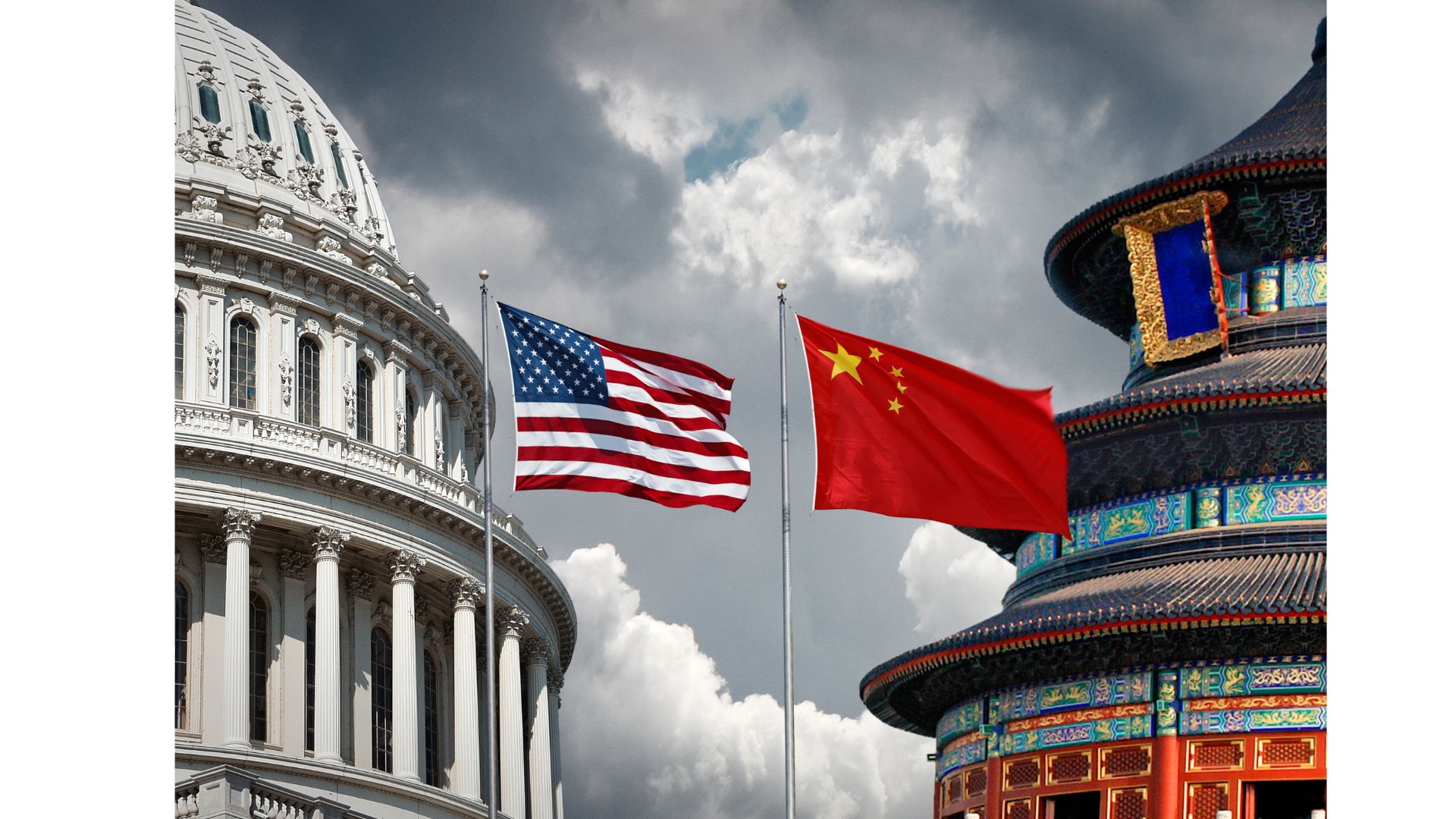
- A second term for Trump could cut America off completely from the world’s second largest economy.
- The most likely scenario for 2025 is a period of tension between the US and China.
The US presidential election is less than three months away. Undoubtedly, the main issue of the election will be the economy and the standard of living. In this light, what will be the US’s relationship with China? After all, the latter is seen as a major competitor and market driver, writes Ambassador Clyde Kull in Postimees.
The global rivalry between the two superpowers and the struggle for leadership, which began during the Obama administration, has increasingly spilled over into the realm of high technology, which is decisive for military, economic and foreign policy capabilities.
The European Union, as the closest ally of the United States, is inevitably also involved in this struggle, and its actions have consequences for the development of Europe’s strategic industrial and defence capabilities, as well as for climate policy.
It would therefore be appropriate to take a look at possible scenarios for the future, depending on which candidate wins the presidential election.
One indicator is the choices made by American technology companies, whose future will be largely determined by the policies of the new administration.
In typical American fashion, Silicon Valley has split into two camps now that Vice President Kamala Harris has become Donald Trump’s official Democratic running mate.
While Trump has in recent months won over heavyweight tech backers such as Elon Musk and the founders of the venture capital firm Andreessen Horowitz, Harris is also backed by some of Silicon Valley’s high profile players, including a group of 750 venture capitalists, driven, as they themselves claim, by a belief in democratic institutions, the rule of law, voting rights, etc. “The two candidates couldn’t be more different from each other on this dimension,” said Eric Rosenblum, head of Foothill Ventures.
But that doesn’t mean Rosenblum and other tech investors won’t be watching closely for signs of how the candidates approach policy areas close to Silicon Valley’s heart, such as crypto, artificial intelligence, the green energy transition and competition with China.
Both camps are clearly anti-China, united by a desire to limit China’s economic growth and global influence, but with different approaches. The disagreement is over which economic and political weapons to use to contain China, and how and when to use them. There was also a great deal of personality and unpredictability in the approach of the first Trump administration. The Biden-Harris administration has been much more professional and predictable.
The difference could be important. While the US and Chinese tech sectors are expected to continue to diverge regardless of who wins in November, much of the sector still prefers the “stable divergence” of the Harris administration to the less predictable Trump administration.
Many experts agree that investing in China has certainly become more difficult in recent years, for a variety of reasons. But a second term for Trump could cut America off completely from the world’s second largest economy.
Silicon Valley venture capital firms are increasingly contracting their operations in the Chinese market, but many prominent players still have stakes in Chinese start-ups and exiting could be a long and difficult process.
According to Darrell West, a senior fellow at the Brookings Institution, a Washington-based think tank, it is difficult to predict how Trump will handle the tech tensions with China.
“It always comes down to personal relationships, and you never know what will provoke him at a particular moment,” he said. “But his general tendency has been to blame China for many different things. One can expect him to continue to do so.”
A glaring example of Trump’s unpredictability is his changing attitude towards TikTok. As president, he was initially behind an attempt to ban the Chinese-owned short video app in the US, but has now reversed course and says he opposes such a move. However, this does not mean that Trump will pursue a more China-friendly policy than Harris.
The Biden administration has been quite circumscribed in its interpretation of how to contain China. It can be expected that Harris, if elected, will continue this ‘controlled and narrow’ approach.
In addition to restricting the export of chips to China, the Biden administration has decided to limit US financial support for the development of Chinese advanced technologies such as artificial intelligence, semiconductors and quantum technologies. Obviously, Harris would not drastically expand the restrictions on technology exports or investment, as American companies continue to have major business interests in China. There is no sign that Harris would want to completely uncouple from China and separate the two economies entirely. However, Harris would continue to pursue a tough policy on technology with military applications.
Trump, on the other hand, could escalate the situation in a number of ways, including by extending restrictions on American investment in China, especially those involving technology sectors. Trump could also pressure American allies and partners to increase restrictions on Chinese investors in artificial intelligence. After all, it is no secret that it was under pressure from the Trump administration that the Dutch company ASML, whose lithography technology underpins the mass production of semiconductor chips, ended its cooperation with China.
What could be China’s possible response to the new administration’s expected moves?
It is in China’s interest to have better intergovernmental and military relations with the US, as developments over the past six months have shown. The main impetus for this is the desire for stability in a context of slowly recovering economic growth after the trauma of the post-COVID-19 closure policy. Further locking of US markets – more likely in the event of a Trump victory – would force China to step up domestic consumption and shift to other foreign markets. Therefore, China itself would not escalate the trade war.
According to Chinese wisdom, they are preparing for the worst, i.e. a Trump victory. The Chinese are trying to puzzle out whether Trump’s threat to impose 60% tariffs on all Chinese exports as part of a broader isolation strategy is the truth behind it, or whether it is simply blackmail for better trade and investment conditions. The biggest concern, however, is if Trump revokes China’s status as a permanent normal trading relationship, which was the basis for China’s entry into the World Trade Organization and economic rise and sustained US-China economic relations for over a generation.
One possibility is that China may try to endure the economic pain caused by Trump, hoping that America’s own economic weakness and China’s reluctance to retaliate may persuade Trump to choose another target. Alternatively, they could turn to various US allies who still depend on good economic relations with China, offering greater market access in return for US pressure. Here, however, there is a risk of generating discontent among China’s own producers, who may direct it at their own leadership.
The worst option would be to respond by security policy means, such as a military and diplomatic campaign against Taiwan. Admittedly, China could also take a friendlier approach aimed at making anti-China policies less politically popular in the US. For example, by offering investment and job creation in the US and limiting its exports to some mutually acceptable level. However, Trump may see such moves as a sign of weakness and instead reinforce his strategy of pressure. Nor is it in China’s interest to converge on US positions on the wars in Ukraine and the Middle East. The end of these conflicts could allow the US to focus even more attention on China and give impetus to a “tougher policy towards China”.
So the most likely scenario for 2025 is a tense period in which the new administration in Washington and the Chinese leadership weigh up each other’s strengths and weaknesses. Perhaps the best either side can hope for is that today’s economic uncertainty will encourage pragmatism on both sides, limiting further damage to the world’s most important bilateral relationship.
https://arvamus.postimees.ee/8081538/clyde-kull-mis-saab-hiinast-peale-ameerika-presidendivalimisi